
Powered by the Sun: How a Rooftop Solar Panel System Works and its Projected Payback Period
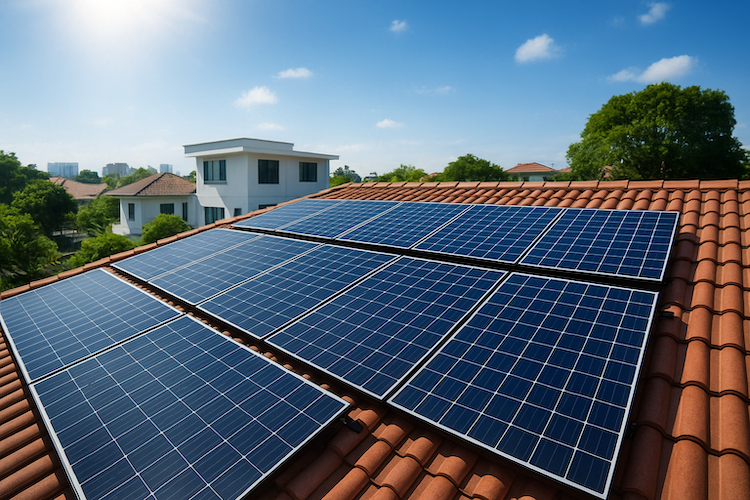
Solar energy adoption in Singapore and Malaysia has grown rapidly as homeowners look for reliable ways to reduce electricity bills and lower their carbon footprint. Today, rooftop solar panels power homes, commercial buildings, road signage and even spacecraft – but how exactly do they work? This guide explains how a residential solar panel system converts sunlight into clean, renewable electricity for your home.
How Rooftop Solar Panels Capture Sunlight
Rooftop solar panels generate electricity by absorbing sunlight – even during cloudy weather. Each panel contains photovoltaic (PV) cells that convert solar energy into usable electrical power. This makes rooftop solar one of the most efficient and accessible renewable energy solutions for home owners.
How Photovoltaic Cells Produce Electricity
Inside every solar panel are layers of semiconductor materials such as silicon. When photons from the sun hit these layers, they energise electrons and create an electric field. This process, known as the photoelectric effect – generates direct current (DC) electricity that forms the basis of solar power generation.
From Direct Current (DC) to Alternating Current (AC)
Solar panels naturally produce DC power. Before this electricity can be used in your home, it must be converted into alternating current (AC) through a solar inverter. Once converted, your home’s consumer unit distributes the clean electricity to appliances and lighting, reducing reliance on grid power and lowering your monthly utility bills.
Exporting and Selling Surplus Solar Energy
If your solar system generates more power than your building consumes, the excess electricity is usually exported to the national grid. Export meters track this energy, and building owners receive payments through their electricity bill adjustment based on the prevailing export rates.
Projected Solar Panel Payback Period across Southeast Asia
(In this post, we will focus on projected payback period for Residential solar PV systems first and we will prepare another separate post for commercial and industrial (C&I) solar PV systems)
For many homeowners, the projected solar payback period (how long it takes for savings to cover the upfront cost) is a key factor when deciding to install solar panels.
Singapore: The projected residential solar PV system payback period in Singapore is about 4–6 years, with some households achieving 3–5 years (making it one of the shortest payback periods across the region together with Vietnam, see below), depending on the individual energy consumption behaviour, system size/cost, and electricity tariffs.
Malaysia: The projected payback period for a residential solar PV system in Malaysia ranges from 4 to 8 years, with some households achieving 3–6 years payback period, depending on the individual energy consumption behaviour, system size/cost, the national net-metering policies, and electricity tariffs.
Thailand: Residential systems’ projected payback period is between 5 to 10 years, while some have reported 3–7 years payback period. A lot of this variation is due to its government incentives, the individual energy consumption behaviour, system size, and installation costs.
Vietnam: Vietnam has one of the shortest projected payback periods (together with Singapore) with some residential solar PV systems coming in at 3–5 years for high energy consumption homes while generally it is around 4–7 years, influenced by net-metering policies and tariffs, the individual energy consumption behaviour, and system size/cost.
Indonesia: Most rooftop solar PV systems in Indonesia achieve payback in 5–10 years, largely due to its current net-metering policies and tariffs, which currently limits export credits, and also depending on the individual energy consumption behaviour, location (which affect the export policies and tariffs), and government incentives.
Compared with neighbouring countries, Singapore, Malaysia and Vietnam have a relatively shorter payback period for residential solar PV systems, especially for households with higher daytime energy consumption but as you can see, part of it depends on the net-metering policies and tariffs.
Ready to Switch to Solar?
If you’re a homeowner looking to take charge of your energy future (we are currently taking in enquiries from both Singapore and Peninsular Malaysia home owners), XSolar is here to help every step of the way to help build a solar PV system with one of the shortest payback periods for you and your family. Contact our team today and take that first step toward sustainability, lower energy bills, and long-term value.
Let’s make your rooftop work for you – powered by the sun! 🌞
Comments